

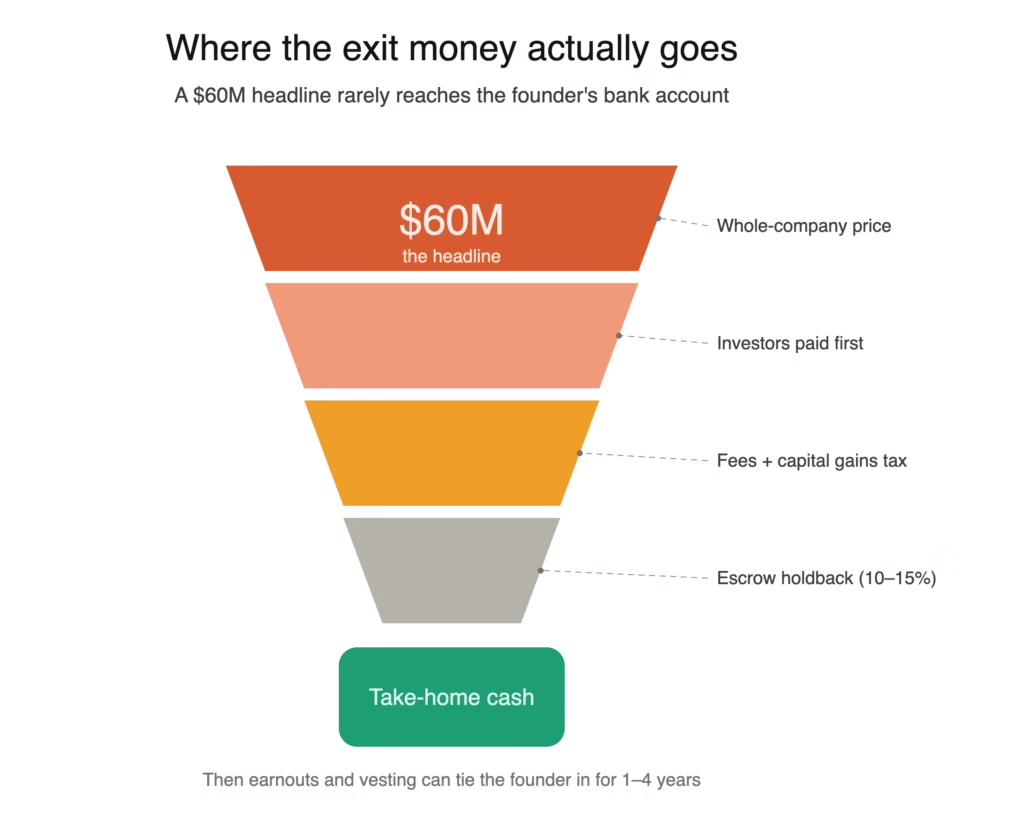
A founder sells their company for $60 million. The headline goes viral. Friends send champagne emojis. The press calls it a “blockbuster exit.”
Then the wire transfer arrives — and it is a fraction of the number everyone is celebrating.
This is the single most misunderstood event in the startup world. The startup founder payout after sale is rarely the price you read in the news. Between the announcement and the founder’s bank account sits a long line of people who get paid first: preferred investors, the government, lawyers, escrow agents, and sometimes the buyer itself.
This guide breaks the whole thing down in plain language — with step-by-step math for both a global multi-billion-dollar deal and the Indian startup ecosystem. By the end, you will understand exactly why the headline is a story, and the wire transfer is the truth.
Pillar 1: The Core Illusion — Why the Headline Number Is a Myth of a Startup.
When a deal is announced, the “price” is the enterprise value or total deal value. It is the price for the entire company. It is not, and never was, the founder’s money.
Think of the headline number as a pizza. The founder rarely eats the whole pizza. They get one slice — and the size of that slice was decided years ago, in term sheets most founders barely read.
Here is the order in which the pizza gets cut, before the founder touches a single dollar:
- The bank and the lawyers eat first. Investment bankers, M&A lawyers, and accountants take transaction fees (often 1–5% of the deal).
- Debt holders get paid. Any loans or convertible notes are repaid off the top.
- Preferred investors take their guaranteed return. This is the big one. We cover it in Pillar 2.
- The employee option pool gets its share. Everyone with stock options converts and cashes out.
- The government takes its cut. Capital gains taxes apply to whatever is left for the founder.
- The buyer holds money back. A chunk goes into an escrow account as a safety deposit (Pillar 4).
Only after all of that does the founder see their real number. It is entirely possible — and shockingly common — for a founder to “sell for millions” and walk away with a modest sum, or in worst cases, almost nothing. Plenty of founders have publicly described how they managed to lose everything in a big exit despite a headline that sounded like generational wealth.
If you have ever wondered what the financial outcome is for a founder when they sell, the honest answer is: it depends entirely on the cap table and the contract, not the press release.
Pillar 2: The Venture Capital Liquidation Trap of a Startup.
This is where most of the value quietly disappears. To understand it, you need to understand two types of stock.
Common Stock vs. Preferred Stock
- Common stock is what founders and employees hold. It is “last in line” when money is paid out.
- Preferred stock is what venture capitalists (VCs) receive when they invest. It is “first in line” and comes with special protections.
The most important protection is the liquidation preference.
Liquidation Preference, Explained
A liquidation preference guarantees that investors get their money back before common shareholders see anything. This is the heart of any liquidation preference explained discussion.
- 1x preference (the standard): Investors get back exactly what they put in, first. If a VC invested $10 million at 1x, they take $10 million off the top before founders get a cent.
- Multi-x preference (2x, 3x): Investors get back 2 or 3 times their money first. A 3x preference on $10 million means $30 million comes out before founders are paid. These are common in “down” markets or risky deals — and they are brutal for founders in a modest exit.
There are two flavours:
- Non-participating: The investor chooses either their preference or their ownership percentage — whichever is bigger. (Founder-friendly.)
- Participating (“double dip”): The investor takes their preference and then also shares in the remaining money by ownership percentage. (Founder-hostile.)
How Founders Get Diluted to 10–20%
Every funding round sells new shares, which shrinks the founder’s percentage. This is dilution.
A typical journey looks like this:
| Stage | Founder Ownership |
|---|---|
| Day one (just the founders) | 100% |
| After seed round | ~75% |
| After Series A | ~45% |
| After Series B | ~30% |
| After Series C + employee pool | ~15–20% |
By the time a venture-backed company exits, the founder often owns just 10–20% of the company. Combine a small ownership slice with a fat liquidation preference, and you get the trap: in a disappointing exit, preferred investors can take the entire payout, leaving common shareholders — the founders and employees — with zero.
The cruel irony: the company “sold for $50 million,” and the founder got nothing, because investors had a $60 million preference stack.
Pillar 3: The Exact Math (Step-by-Step Case Studies)
Enough theory. Let’s run real numbers. We’ll do one global mega-deal and two Indian deals, because the tax mechanics are very different.
Key idea: In a large exit, liquidation preferences usually stop mattering — because preferred investors get more by simply converting to common stock than by taking their preference. So in big deals, the real “trimmer” is tax. In small exits, the preference is what destroys the founder’s payout.
Case Study A: The Global Multi-Billion-Dollar Deal (US Context)
Scenario: A company is acquired for $60 billion (all cash). The founder owns 20% of common stock. The company raised roughly $8 billion across its life at standard 1x non-participating preferences.
Step 1 — Do the preferences bite? At a $60 billion exit, every preferred investor would rather convert to common stock (their ownership %) than take their $8 billion preference, because their as-converted shares are worth far more. So the preference converts away and does not reduce the founder’s slice. The founder keeps their full 20%.
Step 2 — Apply taxes. This is a US example, so the founder pays:
- Federal long-term capital gains: 20% (top rate) + 3.8% Net Investment Income Tax = 23.8%
- State tax (California, top rate): 13.3%
- Founder’s cost basis is near zero, so essentially the entire payout is taxable gain.
| Step | Amount |
|---|---|
| Headline acquisition price | $60.0 billion |
| Founder’s stake (20% common) | $12.0 billion |
| Less: liquidation preference (converts at this scale) | –$0 |
| Less: founder’s pro-rata deal/banker fees (~1.5%) | –$0.18 billion |
| Pre-tax proceeds | $11.82 billion |
| Less: US federal tax @ 23.8% | –$2.81 billion |
| Less: California state tax @ 13.3% | –$1.57 billion |
| NET TAKE-HOME | ≈ $7.44 billion |
The reality: A “$60 billion” headline becomes roughly $7.4 billion for a 20%-owning founder — about 12% of the headline number. They lose nearly $4.4 billion to tax alone. And this is the best-case scenario where preferences don’t bite.
A note on cash vs. stock acquisition: If part of this deal were paid in the buyer’s stock instead of cash, the founder could defer some tax — but they’d be exposed to the buyer’s share price swinging, plus lock-up periods that stop them from selling. A “$60 billion stock deal” can shrink if the acquirer’s stock falls before the founder is allowed to sell.
Case Study B: The Indian Startup Ecosystem
India’s startup founder payout after sale math is driven by one number: the holding period. India’s tax code treats a patient founder very differently from an impatient one.
For unlisted shares (which is what almost all startup equity is):
- Held more than 24 months → Long-Term Capital Gains (LTCG): 12.5% base, with no indexation.
- For a high earner, add the 15% surcharge (capped at 15% on capital gains) and the 4% Health & Education Cess.
- Effective rate = 12.5% × 1.15 × 1.04 = ~14.95%.
- Held 24 months or less → Short-Term Capital Gains (STCG): taxed at your income slab rate. For a top-bracket founder under the new regime, that’s 30% + 25% surcharge + 4% cess = an effective ~39%.
This is the most important sentence in the entire Indian startup capital gains tax conversation: selling one day too early can roughly triple your tax bill.
Note: We use a 50% founder stake here. That’s higher than a heavily VC-funded startup (where founders dilute to 10–20%) — so picture a bootstrapped or lightly funded company.
Deal 1: A ₹100 Crore Acquisition (Founder owns 50%)
| Step | Long-Term (held > 24 months) | Short-Term (held < 24 months) |
|---|---|---|
| Acquisition price | ₹100 Cr | ₹100 Cr |
| Founder’s 50% stake | ₹50 Cr | ₹50 Cr |
| Effective tax rate | 14.95% | ~39% |
| Tax paid | –₹7.48 Cr | –₹19.50 Cr |
| NET TAKE-HOME | ≈ ₹42.5 Cr | ≈ ₹30.5 Cr |
The penalty for impatience: ₹12 Crore. Same deal, same stake — the only difference is the calendar.
Deal 2: A ₹1,000 Crore Acquisition (Founder owns 50%)
| Step | Long-Term (held > 24 months) | Short-Term (held < 24 months) |
|---|---|---|
| Acquisition price | ₹1,000 Cr | ₹1,000 Cr |
| Founder’s 50% stake | ₹500 Cr | ₹500 Cr |
| Effective tax rate | 14.95% | ~39% |
| Tax paid | –₹74.75 Cr | –₹195 Cr |
| NET TAKE-HOME | ≈ ₹425 Cr | ≈ ₹305 Cr |
The penalty for impatience here: ₹120 Crore. That is a beach house, a school endowment, and a venture fund — lost to a missed date on the calendar.
Saving Tax After the Sale
Indian founders sometimes reinvest gains into residential property to reduce tax. But this isn’t unlimited — Section 54F has a strict ₹10 crore exemption cap, so a founder cashing out ₹500 crore can only shelter a small slice this way. At large scale, there is no easy escape from the tax bill.
Pillar 4: Deal Mechanics — Escrow & Indemnity Clauses
Even after tax, the founder still doesn’t get all their money on closing day. Welcome to the escrow account business acquisition mechanism — the buyer’s safety net.
The Indemnity Clause: A Financial Insurance Policy for the Buyer
When you sell a company, you make dozens of legal promises about its condition. These are called Representations & Warranties (R&Ws) — for example:
- “We own all our code and intellectual property.”
- “We have paid all our taxes.”
- “There are no lawsuits we haven’t disclosed.”
- “Our financial statements are accurate.”
The indemnity clause is the founder’s promise to pay the buyer back if any of those statements turn out to be false. In effect, the founder is the buyer’s insurance company. If a hidden tax bill or lawsuit surfaces after the sale, the indemnity clause startup exit mechanism forces the seller to cover it.
If indemnity were unlimited, no founder would ever sell. So three protective shields keep it fair:
- 1. Indemnity Cap (10–25% of deal value): The maximum the founder can ever be forced to pay back. A 20% cap on a $100M deal means the founder’s exposure is limited to $20M — not the whole price.
- 2. Basket / De Minimis Thresholds: Small claims don’t count. A de minimis filters out tiny, nuisance claims (e.g., anything under $25,000). A basket is a deductible — claims must pile up past a threshold (say $500,000) before the buyer can collect anything.
- 3. Survival Period (12–24 months): Promises have an expiry date. After this window passes with no claims, the founder is off the hook.
Why the Buyer Holds 10–15% in Escrow
To make sure the indemnity promise has teeth, the buyer doesn’t pay 100% at closing. They place 10–15% of the cash into an escrow account — a neutral, locked third-party account. If a valid claim arises during the survival period, the buyer pulls cash from the escrow instead of chasing the founder personally. Whatever is left at the end is released to the sellers.
Here is exactly how a claim flows through the system:
        ACQUISITION PRICE: $100M
                  │
                  ▼
        ┌──────────────────────────┐
        │  85–90% paid at CLOSING   │ ──►  Founders, investors, employees
        └──────────────────────────┘
                  │
                  ▼
        ┌──────────────────────────┐
        │  10–15% LOCKED IN ESCROW  │  (held by neutral third party)
        └──────────────────────────┘
                  │
                  │   Survival period clock starts (12–24 months)
                  ▼
          Does a breach / claim arise?
            │                     │
           YES                    NO
            │                     │
            ▼                     ▼
     Buyer files an        Full escrow released
     indemnity claim       to sellers at expiry
            │
            ▼
     Claim bigger than    ──NO──►  Ignored (too small)
     DE MINIMIS?
            │
           YES
            ▼
     Total claims past    ──NO──►  Buyer absorbs it
     the BASKET?
            │
           YES
            ▼
     Cash pulled FROM ESCROW
     (never more than the CAP: 10–25%)
            │
            ▼
     Remaining escrow released
     to sellers at survival expiry
The takeaway: even a clean, friendly acquisition typically means 10–15% of the founder’s cash is invisible for a year or two, sitting in escrow, waiting to see if any skeletons fall out of the closet.
Pillar 5: Post-Acquisition Realities — The Golden Handcuffs
The final twist: in many deals, the founder doesn’t even get to leave. A large part of the payout is tied to the founder staying and performing.
Earnouts and Milestones
An earnout holds back a portion of the price and pays it only if the company hits future targets after the sale — revenue goals, user growth, product launches.
- A $100M deal might be structured as $60M upfront + $40M earnout over two years.
- If the targets are missed (and post-acquisition, the founder often no longer fully controls the company), that $40M can simply evaporate.
- Buyers love earnouts because they shift risk onto the seller. Founders should treat earnout money as a maybe, not a yes.
Vesting and Retention Packages
To stop the founder from cashing out and disappearing, buyers attach re-vesting schedules to a chunk of the consideration. The founder must keep working — typically as a CEO or executive for 1 to 4 years — to unlock the full amount.
- Quit early, and you forfeit the unvested portion.
- These golden handcuffs are why so many acquired founders stay at the parent company for years, even when they’d rather start something new.
The emotional reality is often jarring: you sold your company, but you now have a boss, a quota, and a multi-year contract standing between you and your full payout.
The Bottom Line: From Headline to Bank Account
Let’s stack up everything that happens between the press release and the wire transfer:
| The Headline Says | The Reality Is |
|---|---|
| “Sold for $X” | That’s the price for the whole company, not the founder |
| “Founder is rich” | Investors with liquidation preferences get paid first |
| “100% cash deal” | 10–15% sits in escrow for 1–2 years |
| “Clean exit” | Indemnity clauses can claw money back |
| “Founder cashes out” | Earnouts & vesting lock them in for 1–4 years |
| “Tax-free windfall” | 15–37%+ vanishes to capital gains tax |
A founder’s real payout is the product of a long chain of subtractions: dilution × ownership × (1 − liquidation preferences) × (1 − fees) × (1 − tax) × (escrow released) × (earnout achieved).
The lesson for any founder isn’t to be discouraged — it’s to read the term sheet before you sign it, not after you sell. The deal you negotiate at the seed stage decides how big your slice will be at the exit. By then, the math is already written.
This article is for educational purposes only and is not financial, tax, or legal advice. Tax rates, exemption limits, and deal structures change and vary by jurisdiction and individual circumstances. Always consult a qualified chartered accountant, tax advisor, or M&A attorney before making decisions about an acquisition or your equity.